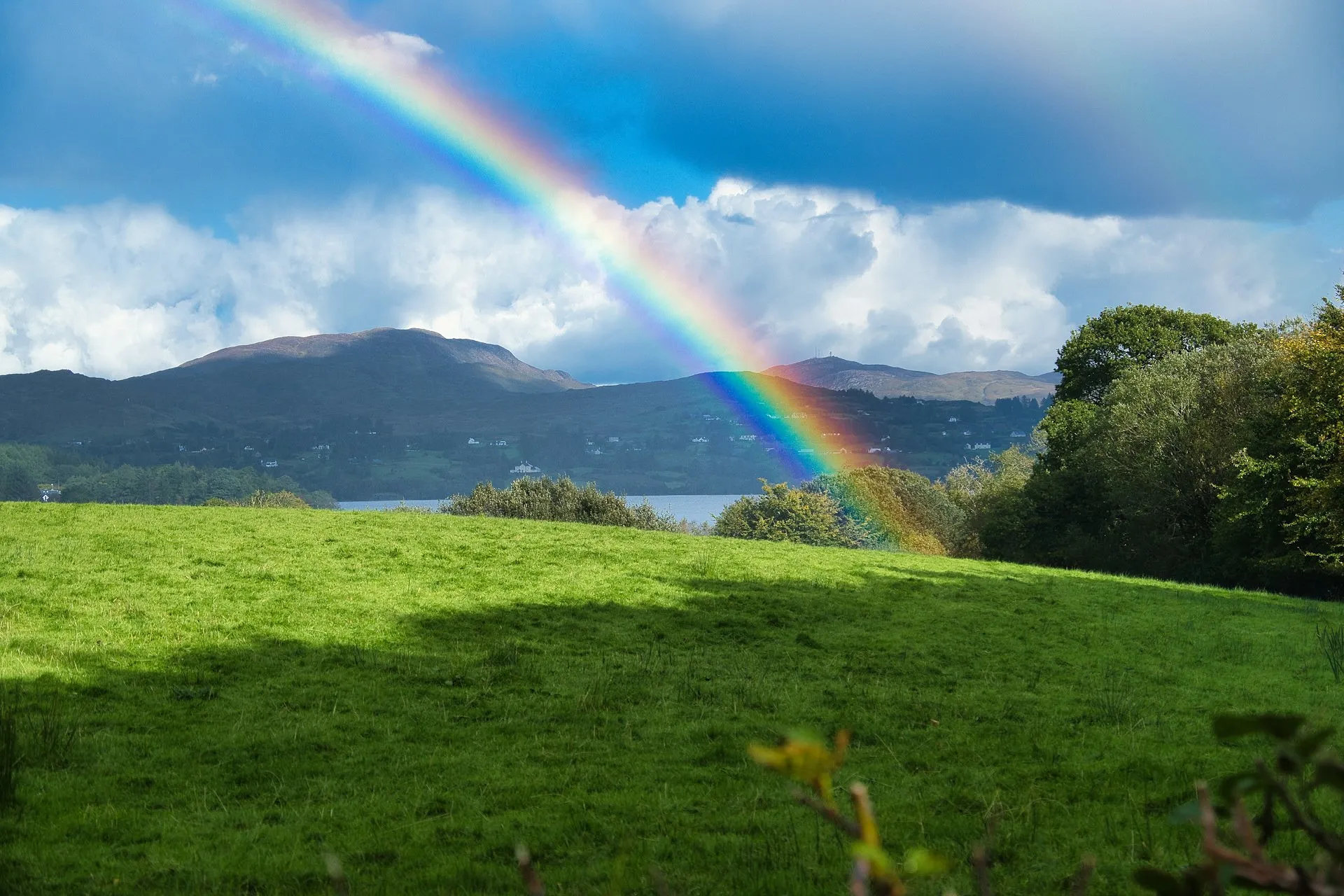
Irish weather is mild, wet and changeable in every month, with no extreme heat or cold. Dublin averages 5.2°C (41°F) in January and 15.4°C (60°F) in July, and it rains on about 137 days a year there, with more rain in the west.
Plan for a day that can switch between sun and showers, and pack layers. The table below shows what each month usually brings.
What is the weather in Ireland month by month?
These are Met Éireann 30 year averages. Dublin and Shannon use 1991 to 2020. Met Éireann has no 1991 to 2020 figures for Malin Head, so it uses the older 1981 to 2010 set. Temperature is the monthly mean in °C, and rain is the monthly total in mm.
| Month | Dublin °C | Dublin rain mm | Shannon °C | Shannon rain mm | Malin Head °C | Malin Head rain mm |
|---|---|---|---|---|---|---|
| January | 5.2 | 62 | 6.1 | 104 | 5.9 | 117 |
| February | 5.3 | 52 | 6.3 | 87 | 5.8 | 85 |
| March | 6.6 | 51 | 7.5 | 76 | 6.9 | 86 |
| April | 8.2 | 55 | 9.6 | 62 | 8.3 | 63 |
| May | 10.7 | 57 | 12.0 | 63 | 10.5 | 57 |
| June | 13.3 | 64 | 14.5 | 70 | 12.7 | 69 |
| July | 15.4 | 61 | 16.0 | 76 | 14.5 | 77 |
| August | 15.1 | 73 | 15.8 | 88 | 14.7 | 93 |
| September | 13.2 | 63 | 14.1 | 77 | 13.3 | 92 |
| October | 10.4 | 78 | 11.2 | 96 | 10.8 | 118 |
| November | 7.3 | 83 | 8.3 | 107 | 8.2 | 105 |
| December | 5.5 | 72 | 6.4 | 115 | 6.4 | 114 |
Sources: Dublin Airport, Shannon Airport and Malin Head. For °F, 5°C is 41°F, 10°C is 50°F, 15°C is 59°F and 20°C is 68°F.
Dublin’s average daily high peaks at 19.5°C (67°F) in July and falls to 8°C (46°F) in January. Sunshine runs from 1.7 hours a day in December to 6.4 hours in May. The sunniest months for sightseeing are May to September, which is why our best time to visit Ireland guide points most visitors there.
Is the west really wetter than the east?
Yes. Annual rainfall in Dublin is 772 mm over 137 days with 1 mm or more. At Valentia in Kerry it is 1,557 mm over 187 days, using the 1981 to 2010 set. Malin Head in Donegal falls between, at 1,076 mm.
For you, that means a trip along the Ring of Kerry or the west coast needs more flexible plans than a trip around Dublin. Our Ring of Kerry guide, Connemara guide and Malin Head guide all cover rain plans. Valentia has 22 days with at least 0.2 mm of rain in both December and January.
Good to know: Even the wettest places are not wet all day. The 137 and 187 day figures count days with 1 mm or more of rain, which can be a single shower. Plan for stop start weather rather than constant rain.
How windy is the Atlantic coast?
Very, especially from October to March. At Malin Head the mean wind speed is 12.3 knots in July and 19.0 knots in January. The station averages 11.8 days of gales in January and 65 days a year.
Wind matters most at cliffs and exposed headlands. Slieve League, the Cliffs of Moher and Malin Head can be unpleasant or unsafe in strong wind. Check boat trips on the day. See our Slieve League guide and Wild Atlantic Way in Donegal for advice.
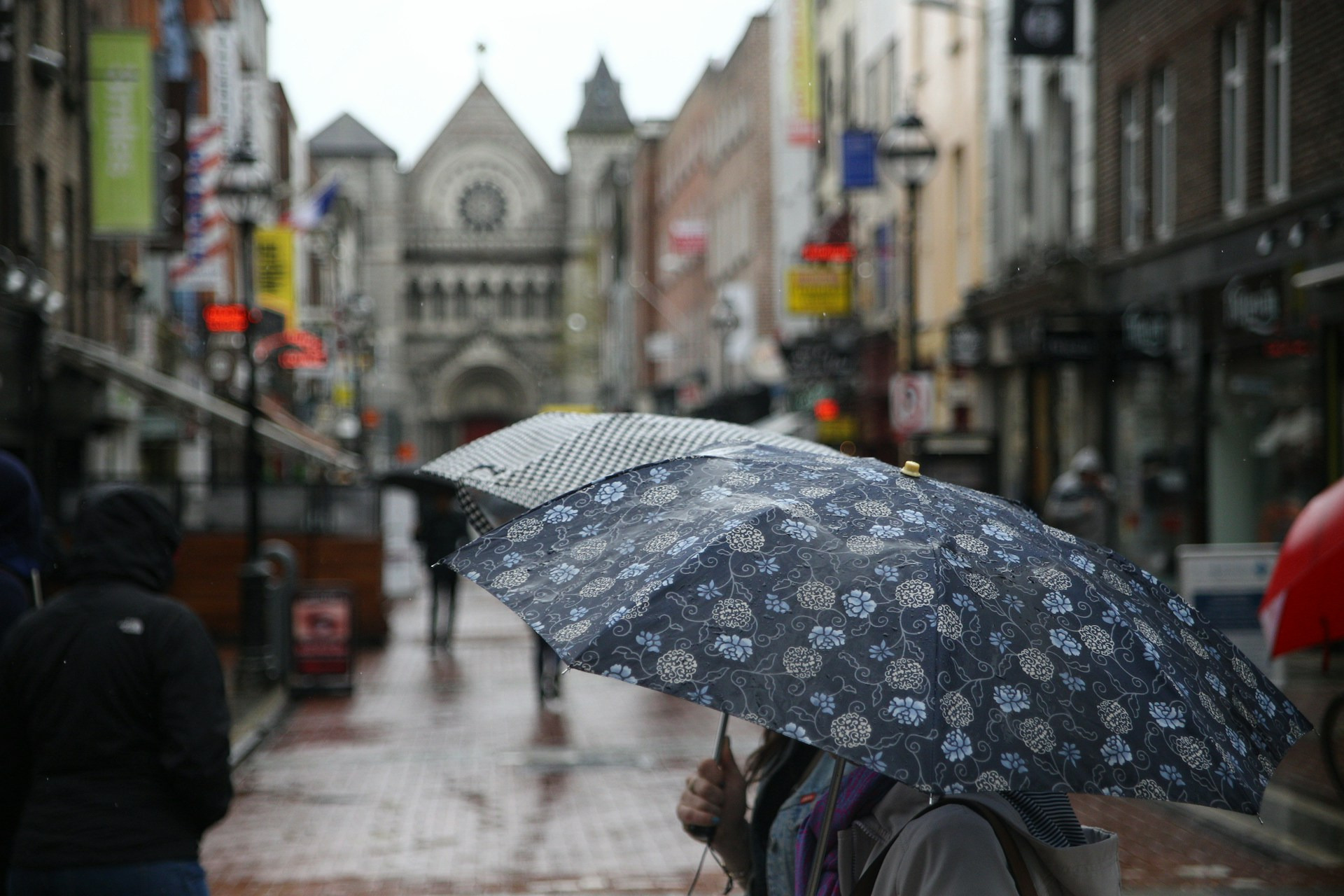 Photo: Jaleel Akbash, via Unsplash
Why do forecasts change so much?
Weather systems arrive from the Atlantic and can change quickly, so forecasts shift from day to day.
In practice, trust the forecast for today and tomorrow, treat day 3 and later as a guide, and check again each morning on met.ie. Look at the hourly forecast before you drive to a viewpoint.
What do the yellow, orange and red weather warnings mean?
Met Éireann uses three colours. Warnings are issued when severe weather is expected within 48 hours.
- Yellow, “Be Aware”: A warning for people at risk because of where they are or what they are doing, so they can take precautions.
- Orange, “Be Prepared”: Conditions that could affect people in the area significantly. The government’s Storm Éowyn advice for orange areas was to limit travel to essential journeys.
- Red, “Take Action”: A severe and comparatively rare warning. During the Storm Éowyn red warning, the Irish government advised people to stay indoors and avoid unnecessary travel. Public transport did not operate, and schools closed.
Rain thresholds for red are more than 50 mm in 6 hours, or more than 80 mm in 24 hours. The wind threshold is widespread mean speeds above 80 km/h or gusts above 130 km/h, according to the Irish Examiner.
If your area has an orange warning, change your plans. If it has a red warning, stay put, and contact your airline or ferry operator for any changes.
What about Northern Ireland?
Northern Ireland uses the Met Office, not Met Éireann. Its colours are yellow, amber and red, and red means serious harm is highly likely. Amber is the middle level, and it signals a greater chance of transport closures and power cuts. Check the Met Office warnings page when you cross the border. See Ireland vs Northern Ireland for other differences.
How do you plan around rain?
- Book indoor and outdoor options for the same day, and do the outdoor one first when the forecast looks best.
- Check the Met Éireann app. It is free and shows a 7 day forecast, a rain radar that updates every 5 minutes and active warnings.
- Pack a waterproof jacket and shoes that dry quickly. Our what to pack for Ireland guide has a list.
- Keep a rainy day plan for each stop, such as Dublin on a rainy day.
- Leave a spare day in the west of Ireland for weather.
Questions people ask
What is the rainiest month in Ireland?
In Dublin it is November, with 83 mm. In the west, Shannon is wettest in December, with 115 mm, and Malin Head in October, with 118 mm.
What is the warmest month in Ireland?
July in most places. Dublin averages 15.4°C (60°F) in July, with an average daily high of 19.5°C (67°F).
Does it snow in Ireland?
Rarely. Dublin averages 5.2°C (41°F) in January, and Ireland.com describes snow in December as rare.
How often does it rain in Ireland?
Often, but not all day. Dublin has about 137 days a year with 1 mm or more of rain, and Valentia has about 187.
What is a red weather warning in Ireland?
It is Met Éireann’s highest warning, for extremely dangerous weather. Stay indoors, avoid travel and expect public transport to stop.
Which app is best for Irish weather?
Use the Met Éireann app for Ireland. For Northern Ireland, also check the Met Office.
Sources
- 30 year averages, Met Éireann
- Dublin Airport 1991 to 2020 averages, Met Éireann
- Shannon Airport 1991 to 2020 averages, Met Éireann
- Valentia 1981 to 2010 averages, Met Éireann
- Malin Head 1981 to 2010 averages, Met Éireann
- Forecasts, Met Éireann
- Met Éireann weather warning system, gov.ie
- National Emergency Co-ordination Group meets as red weather warnings issued, gov.ie
- Met Éireann weather warnings: what warrants a status red alert, Echo
- ieExplains: the difference between the Met Éireann weather warnings, Irish Examiner
- How are weather warnings categorised, Met Office
- UK weather warnings Northern Ireland, Met Office
- December in Ireland, Ireland.com
- Met Éireann Weather Ireland app, Apple App Store
Read next: Ireland in winter: is it worth visiting from November to February?
Cover photo: David Cashbaugh, via Unsplash.
See it with a local guide
Private tours across Ireland, run by the guides themselves. Ask a question or request a date, nothing to pay until they confirm.
Browse tours